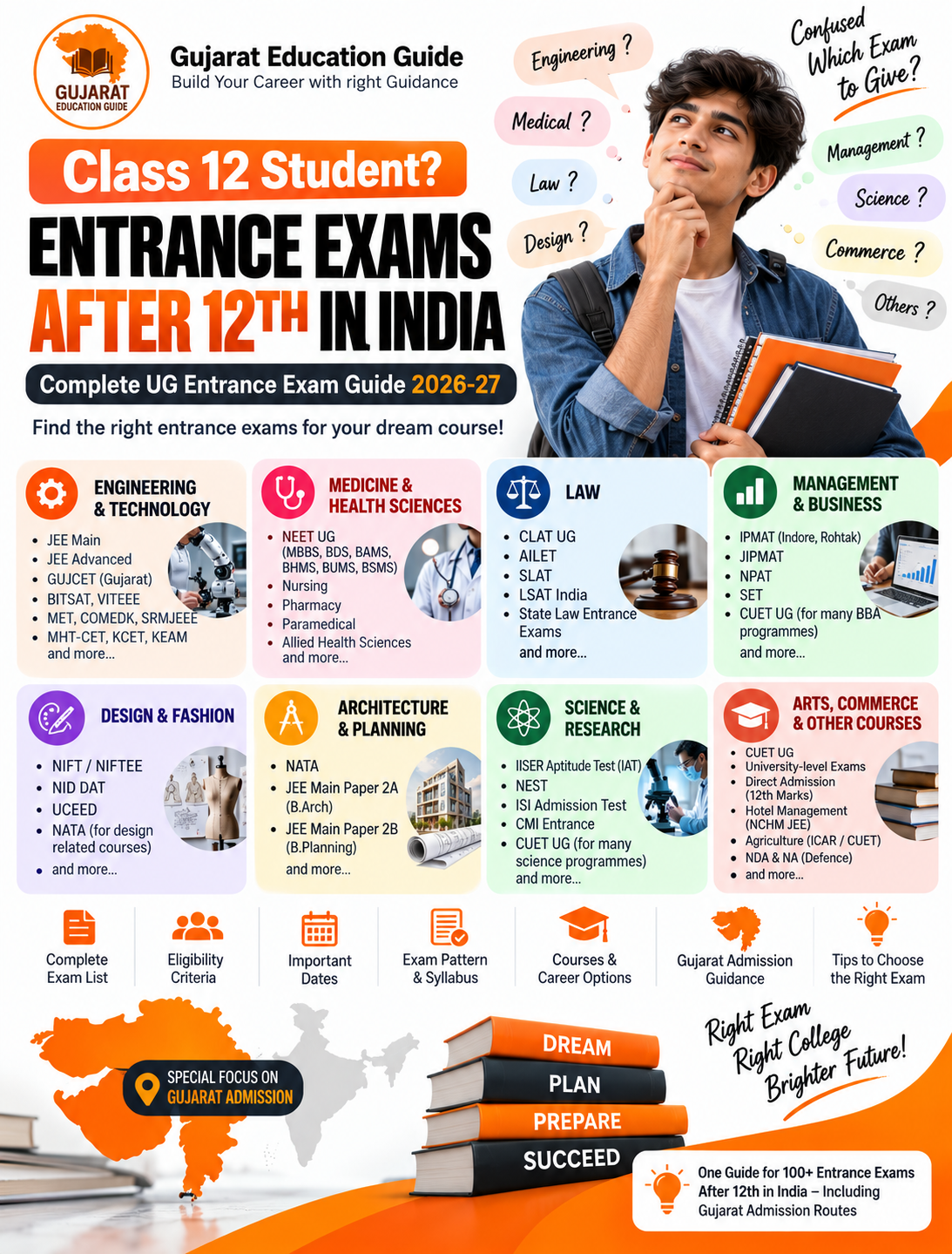
Career Counselling in Ahmedabad: Complete Guide to Career Options, Course Selection, Fees and Admission Guidance (2026–27)
Choosing the right career is one of the most important decisions in a student's life. The decision can influence the subjects a student studies, the course they pursue, the college they attend and the professional opportunities they explore in the future.
However, many students and parents find this decision confusing. After Class 10, students must decide which stream or educational pathway to choose. After Class 12, they must compare courses, entrance examinations, colleges and universities. Even graduates may need guidance when selecting postgraduate programmes, professional qualifications or specialised career pathways.
Today, students can choose from a wide range of programmes in Engineering, Medical and Healthcare, Pharmacy, Management, Commerce, Design, Architecture, Law, Science, Computer Applications, Technology and many other fields. More choices create more opportunities, but they also make it important to understand each option before making a decision.
Career counselling in Ahmedabad can help students and parents organise these choices, understand their academic options and make informed educational decisions.
Gujarat Education Guide (GEG) provides career and admission guidance to help students explore career fields, compare courses, understand eligibility requirements, evaluate colleges and plan their next educational steps.
This comprehensive guide explains what career counselling involves, why students may need it, career options after Class 10 and Class 12, the counselling process, psychometric assessment, college selection, admission planning and the counselling packages available at Gujarat Education Guide.
1. What Is Career Counselling?
Career counselling is a structured guidance process that helps students understand their interests, strengths, academic background, preferences and future educational goals.
It helps students explore different career fields, understand the courses associated with those fields and compare the educational pathways required to pursue them.
Career counselling is not simply about recommending one course. It involves understanding the student's profile, identifying relevant possibilities, evaluating practical considerations and helping the student make an informed choice.
What Does Career Counselling Include?
- Understanding the student's academic background and qualifications.
- Discussing interests, strengths and subject preferences.
- Exploring suitable career fields and educational pathways.
- Comparing traditional degrees and specialised programmes.
- Understanding course eligibility and entrance examination requirements.
- Exploring relevant colleges and universities.
- Comparing course curriculum, duration and fees.
- Understanding available higher education and professional pathways.
- Preparing a practical education and career roadmap.
- Helping students and parents identify the next steps in the decision-making process.
The final decision should consider the student's interests, abilities, academic performance, goals, financial circumstances and available educational opportunities.
2. Why Do Students Need Career Counselling in Ahmedabad?
Ahmedabad and the wider Gujarat region offer students opportunities across Engineering, Medical and Healthcare, Pharmacy, Management, Commerce, Design, Architecture, Law, Science, Technology and many other educational fields.
Students may have access to multiple universities, colleges, professional programmes and admission pathways. However, they may not always know how to compare these options or identify which ones are relevant to their academic profile.
Common Challenges Faced by Students
- Stream selection confusion: Students completing Class 10 may be unsure whether to choose Science, Commerce, Arts, Diploma or another pathway.
- Course selection confusion: Class 12 students may know their preferred stream but remain unaware of the different courses available within it.
- Specialisation confusion: Students may find it difficult to compare fields such as Artificial Intelligence, Data Science, Cybersecurity, Biotechnology and other specialised areas.
- College selection confusion: Students may not know how to compare universities, course structures, fees, facilities and placement information.
- Eligibility confusion: Different courses may have different subject requirements, minimum marks and entrance examinations.
- Admission process confusion: Students may need help understanding application procedures, counselling rounds, choice filling and document requirements.
- Parent-student differences: Parents and students may have different expectations about the right course or career.
- Future planning: Students may be unsure about postgraduate education, professional qualifications or alternative career pathways.
Career guidance helps students examine these questions systematically instead of making decisions only on the basis of trends, advertisements, peer pressure or incomplete information.
3. Career Options After Class 10
After completing Class 10, students generally begin considering their next academic pathway. This is an important stage because the subjects and qualifications selected may influence the courses available to them later.
Science Stream
Science may be suitable for students interested in scientific subjects, mathematics, technology, healthcare and research. Depending on the subjects studied and the applicable eligibility requirements, students may later explore Engineering, Medical, Pharmacy, Biotechnology, Computer Science and other programmes.
Commerce Stream
Commerce introduces students to areas such as accounting, business, economics, finance and management. Future study options may include B.Com, BBA, Economics, Finance and professional qualifications such as CA, CS and CMA.
Arts and Humanities
Arts and Humanities allow students to explore subjects and fields such as Psychology, Law, Journalism, Political Science, Sociology, Languages, Social Sciences and other areas.
Diploma and Vocational Education
Students may also explore diploma and vocational pathways, depending on their interests, eligibility and long-term educational goals. These options can provide technical, practical or skill-oriented learning.
Comparison of Educational Pathways After Class 10
| Educational pathway | Areas students may explore | Important consideration |
|---|---|---|
| Science | Engineering, Healthcare, Pharmacy, Technology, Biotechnology | Subject combination and future course eligibility |
| Commerce | Accounting, Finance, Economics, Business and Management | Interest in business, numbers, finance and commerce |
| Arts / Humanities | Psychology, Law, Journalism, Social Sciences and Languages | Interest in humanities, communication and social subjects |
| Diploma | Engineering and technical education | Programme eligibility and future progression options |
| Vocational education | Skill-based and professional pathways | Practical learning and recognised qualification |
There is no single stream that is best for every student. The appropriate pathway depends on academic performance, interests, subject preferences, eligibility and future goals.
4. Career Options After Class 12 Science
Science students can explore a wide range of educational opportunities. The options available depend on the subjects studied, the course-specific eligibility requirements and the entrance examination rules applicable to the programme.
4.1 Career Options for PCM Students
Students who have studied Physics, Chemistry and Mathematics may explore Engineering, Technology, Architecture, Computer Applications and pure science programmes.
Engineering and Technology options:
- B.Tech / B.E. Computer Science Engineering
- Artificial Intelligence and Machine Learning
- Data Science
- Cybersecurity
- Information Technology
- Electronics and Communication Engineering
- Electrical Engineering
- Mechanical Engineering
- Civil Engineering
- Mechatronics Engineering
- Robotics and Automation
- VLSI and Semiconductor-related programmes
Other possible study options:
- B.Arch, subject to applicable eligibility and entrance requirements.
- BCA.
- B.Sc. Computer Science.
- B.Sc. Mathematics.
- B.Sc. Physics.
- Other science and technology programmes.
Students should compare the curriculum, practical learning, eligibility, fees and future study opportunities before choosing a specialisation.
4.2 Career Options for PCB Students
Students who have studied Physics, Chemistry and Biology may explore Medical, Dental, Ayurveda, Homeopathy, Pharmacy, Physiotherapy, Nursing, Biotechnology and other life-science or healthcare pathways.
Medical and healthcare options may include:
- MBBS
- BDS
- BAMS
- BHMS
- BPT
- B.Sc. Nursing
- Other eligible allied healthcare programmes
Pharmacy and life-science options may include:
- B.Pharm
- Pharm.D
- Biotechnology
- Microbiology
- Biochemistry
- Clinical Research
- Medical Laboratory Technology
- Other relevant life-science programmes
Not every programme has identical subject requirements or admission procedures. Students must check the latest eligibility criteria and official admission notifications for their chosen course.
5. Career Options After Class 12 Commerce
Commerce students can explore academic and professional pathways in Accounting, Finance, Business, Economics, Banking, Management and Entrepreneurship.
Popular Course and Qualification Options
- B.Com: An undergraduate programme covering areas such as accounting, business, finance and commerce.
- BBA: A management-oriented undergraduate programme that introduces students to business functions and management principles.
- Economics: A pathway for students interested in economic systems, markets, policy and quantitative analysis.
- CA: A professional qualification in accountancy and related areas, governed by the relevant professional body.
- CS: A professional pathway focused on corporate law, governance and compliance.
- CMA: A professional pathway focused on cost accounting, management accounting and financial decision-making.
- ACCA: An international professional accountancy qualification with its own examination and membership requirements.
- Finance and Banking: Study options related to financial services, banking and financial management.
- Business Analytics: A field combining business understanding and data-based analysis.
- Entrepreneurship: A pathway for students interested in developing and managing business ventures.
The right choice depends on whether the student is interested in accounting, finance, management, economics, business operations or another professional area. Students should compare course structure, duration, professional examination requirements and total costs.
6. Career Options After Class 12 Arts and Humanities
Arts and Humanities students can explore several academic and professional fields. These pathways can lead to opportunities in communication, law, social sciences, education, creative industries and other areas.
- Psychology: Study of human behaviour, mental processes and related areas.
- Law: Legal education and professional pathways subject to applicable admission and qualification requirements.
- Journalism and Mass Communication: Media, reporting, communication and content-related fields.
- Design: Creative programmes such as communication, product, fashion and other design disciplines.
- Liberal Arts: Interdisciplinary study across humanities, social sciences and other subjects.
- Social Work: Study and practice related to communities and social development.
- Political Science: Study of political systems, institutions and public policy.
- Public Administration: Study of governance and public organisations.
- Languages and Literature: Language, writing, literature and communication-related pathways.
- Education: Academic pathways related to teaching and education, subject to applicable qualifications.
- Sociology: Study of society, institutions and social behaviour.
- Economics: Study of markets, economic systems and policy.
Students should compare course structure, eligibility, specialisations, practical learning and further education opportunities before selecting a programme.
7. Career Counselling After 10th vs After 12th
Career counselling at both stages can be useful, but the decisions involved are different.
| Factor | After Class 10 | After Class 12 |
|---|---|---|
| Main decision | Stream or educational pathway | Course and college selection |
| Main focus | Subject selection and academic direction | Career field, degree and specialisation |
| Important considerations | Interests, subjects and academic strengths | Eligibility, entrance exams, fees and career goals |
| Possible options | Science, Commerce, Arts, Diploma and other pathways | Degree and professional programmes |
| College planning | Explore future educational pathways | Compare colleges and universities |
| Long-term objective | Select a suitable academic direction | Plan higher education and future career pathways |
Students should avoid choosing a stream or course only because their friends are choosing it or because a particular career is currently popular.
8. Career Planning During Graduation and After Graduation
Career decisions do not end after Class 12. Students who are pursuing or have completed graduation may also need guidance when choosing higher education, professional qualifications or a new career direction.
Options Students May Explore
- MBA: Postgraduate management education.
- PGDM: A postgraduate diploma in management offered by eligible institutions.
- MCA: Postgraduate study in computer applications, subject to applicable eligibility.
- M.Sc.: Postgraduate study in science and specialised disciplines.
- M.Com: Postgraduate study in commerce and related subjects.
- M.Tech: Postgraduate technical education subject to programme eligibility.
- Professional certifications: Qualifications relevant to finance, technology, accounting and other industries.
- Government examinations: Competitive examination pathways subject to their eligibility and selection rules.
- Higher education abroad: International study options based on academic profile, admission requirements and financial planning.
The appropriate next step depends on the student's undergraduate qualification, academic record, interests, entrance examination performance and future goals.
9. What Are the Signs That a Student May Need Career Counselling?
Students and parents may consider career guidance when they experience one or more of the following situations:
- The student is unable to decide between two or more courses.
- The student knows their preferred stream but does not know the available career options.
- The student is choosing a course mainly because friends or relatives recommended it.
- Parents and students have different expectations about the future career.
- The student is unsure about course eligibility and entrance examinations.
- The student wants to compare colleges and universities.
- The student has received examination results but does not understand their admission options.
- The student wants to explore career opportunities beyond popular courses.
- The student is confused between traditional degrees and specialised programmes.
- The student wants a structured education and admission plan.
Career counselling does not mean that a student is weak or unable to make decisions. It is a way to explore important choices with more information and a structured approach.
10. How Does Career Counselling Work at Gujarat Education Guide?
At Gujarat Education Guide, our approach focuses on understanding the student's requirements and helping them explore relevant educational opportunities.
Step 1: Student Profile Understanding
The first step is to understand the student's academic and educational background.
Information considered may include:
- Class 10 academic performance.
- Class 12 academic performance, where applicable.
- Subjects studied.
- Current educational qualification.
- Areas of interest.
- Preferred career fields.
- Academic strengths.
- Future education goals.
- Important practical considerations.
This discussion helps establish the student's current position and educational requirements.
Step 2: Understanding Interests and Strengths
A student may be interested in computers but may not know whether to explore software development, cybersecurity, artificial intelligence, data science or another field.
Similarly, a student interested in healthcare may need to understand the differences between medical, pharmacy, biotechnology and allied healthcare pathways.
The objective is to explore relevant possibilities rather than force the student towards one predetermined career.
Step 3: Identifying Suitable Career Fields
Based on the student's profile and discussions, different career fields can be explored.
| Student interest | Possible fields to explore |
|---|---|
| Computers and technology | Computer Science, IT, AI, Data Science and Cybersecurity |
| Biology and healthcare | Medical, Pharmacy, Biotechnology, Nursing and Allied Healthcare |
| Business and management | BBA, B.Com, MBA pathway and Entrepreneurship |
| Numbers and finance | Accounting, Economics, Finance and Statistics |
| Creativity and design | Graphic Design, Product Design, UI/UX and Architecture |
| Society and communication | Psychology, Law, Journalism and Social Sciences |
These are examples for exploration, not automatic course recommendations. Eligibility and individual suitability must be assessed separately.
Step 4: Course Selection and Comparison
After identifying possible career fields, students can compare the relevant courses.
Important comparison factors include:
- Course eligibility and required subjects.
- Duration and curriculum.
- Entrance examination requirements.
- Tuition fees and other expenses.
- University recognition and applicable course approvals.
- Internship and practical learning opportunities.
- Higher education opportunities.
- Potential career pathways.
Students should understand what they will study, what the programme requires and what options may be available after completing it.
Step 5: College and University Comparison
Choosing the right college is an important part of educational planning. Students should not depend only on advertisements, popularity or a single placement figure.
| Comparison factor | What students should check |
|---|---|
| Recognition | University recognition and applicable course approvals |
| Course | Curriculum, specialisation and duration |
| Fees | Tuition fees and other expenses |
| Placements | Median salary, average salary and placement information |
| Infrastructure | Laboratories, library, classrooms and facilities |
| Faculty | Available faculty and academic support |
| Location | Travel, accommodation and accessibility |
| Opportunities | Internships, projects and higher studies |
Students should check official university information and available evidence before making a final decision.
Step 6: Entrance Examination and Admission Planning
Some courses require entrance examinations or centralised admission procedures.
Depending on the student's selected course, relevant examinations and admission processes may include:
- JEE Main.
- GUJCET.
- NEET UG.
- CUET.
- CAT.
- Other university or programme-specific entrance examinations.
- ACPC admission procedures.
- GCAS admission procedures.
- University-level admission processes.
GEG helps students understand relevant admission procedures and available information. Students must verify current examination and admission rules through the official authorities.
Step 7: Preparing a Career and Admission Roadmap
The final objective is to help students understand their next steps.
A roadmap may include:
- Preferred career fields.
- Suitable courses to explore.
- Eligibility requirements.
- Relevant entrance examinations.
- College comparison points.
- Admission-related requirements.
- Important decisions and next steps.
The roadmap should be practical and based on the student's actual academic situation.
11. What Is Psychometric Career Assessment?
Psychometric career assessment is a structured assessment tool that may help students explore aspects of their interests, preferences, aptitudes or personality-related patterns.
It can provide additional information during career planning. However, a psychometric assessment should not be treated as a test that determines a student's entire future.
What Can a Psychometric Assessment Contribute?
Depending on the assessment instrument, it may provide information about areas such as:
- Interests and preferences.
- Selected aptitude areas.
- Work or learning preferences.
- Personality-related patterns.
- Potential areas for further career exploration.
A student's career decision should also consider academic background, subject preferences, personal interests, learning preferences, career goals, family and financial considerations, course eligibility and available educational opportunities.
At GEG, the Psychometric Career Assessment package includes a computer-based assessment and a detailed 30-page report. The assessment is intended to support the counselling discussion, not replace it.
12. Career Counselling Fees in Ahmedabad: GEG Packages
One of the common questions asked by parents is: How much does career counselling cost in Ahmedabad?
The cost depends on the type of guidance required, the student's academic stage and the services included.
Gujarat Education Guide has defined four counselling packages to address different student requirements.
Package 1: Basic Career Counselling – ₹999
Suitable for: Students who want initial career guidance before their results.
Package includes:
- Student profile understanding.
- Interest and strengths discussion.
- Exploration of 3–5 career fields.
- Basic course options.
- One counselling session.
This package is suitable for students who want to understand possible career directions before making a major educational decision.
Package 2: Psychometric Career Assessment – ₹4,999
Suitable for: Students who want a structured career assessment along with counselling.
Package includes:
- Basic Career Counselling Package 1 at no additional charge.
- Computer-based psychometric assessment.
- Detailed 30-page assessment report.
The package is intended to provide additional information about the student's interests, aptitude and preferences as part of career exploration.
Package 3: Admission Planning – ₹9,999
Suitable for: Students who have received their results and need support with college and admission planning.
Package includes:
- After-result counselling.
- Last five years' cutoff analysis.
- ACPC and GCAS guidance.
- Private university application support.
- Five-page personalised report.
- One-to-one support.
Important: The Psychometric Test is not included in this package.
This package focuses on helping students understand their admission options and prepare a more informed college selection strategy.
Package 4: Complete Career Planning – ₹14,999
Suitable for: Students who want a broader career and admission planning approach.
Package includes:
- Career assessment.
- Course selection guidance.
- Entrance examination planning.
- University comparison.
- Cutoff analysis.
- Seat matrix understanding.
- Complete admission roadmap.
This package combines career exploration with educational and admission planning.
GEG Counselling Package Comparison
| Feature | Basic Career Counselling | Psychometric Assessment | Admission Planning | Complete Career Planning |
|---|---|---|---|---|
| Price | ₹999 | ₹4,999 | ₹9,999 | ₹14,999 |
| Student profile | Yes | Yes | Yes | Yes |
| Interest and strengths discussion | Yes | Yes | As part of counselling | Yes |
| Psychometric assessment | No | Yes | No | Career assessment included |
| Assessment report | No | 30 pages | 5 pages | As per programme deliverables |
| Cutoff analysis | No | No | Yes | Yes |
| ACPC / GCAS guidance | No | No | Yes | Admission roadmap |
| University comparison | Basic exploration | As applicable | Yes | Yes |
| Admission roadmap | No | No | Yes | Complete roadmap |
Package inclusions are based on GEG's defined services. Students should confirm the applicable deliverables and service scope with GEG before enrolment.
13. How to Choose the Right Career Counselling Package?
Not every student requires the same level of counselling. The suitable package depends on the student's current academic stage and requirements.
| Student situation | Package to explore |
|---|---|
| Student is confused about career options before results | Basic Career Counselling |
| Student wants a psychometric assessment and detailed report | Psychometric Career Assessment |
| Student has received results and needs college admission guidance | Admission Planning |
| Student wants career assessment, course selection and admission planning | Complete Career Planning |
Parents and students can discuss their requirements with GEG before selecting a package. The package should be selected according to the student's needs rather than assuming that every student requires the most comprehensive service.
14. How to Choose the Right Career Counsellor in Ahmedabad?
Before selecting a career counselling service, students and parents should understand the counselling process, the services offered and the information used to make recommendations.
1. Does the Counselling Process Understand the Student?
A useful counselling discussion should consider the student's academic background, interests, strengths, subject preferences and future goals.
2. Does the Counsellor Explain Multiple Career Options?
Students should be able to explore different relevant pathways instead of receiving only one predetermined recommendation.
3. Is Course Eligibility Explained Properly?
Course eligibility, subject requirements and entrance examination rules should be checked before making decisions.
4. Is College Comparison Based on Relevant Information?
Students should understand fees, course curriculum, university recognition, placement information and other important factors.
5. Are Fees and Deliverables Transparent?
Parents should know exactly what is included in the selected package, how many sessions or reports are provided and what additional services may require separate charges.
6. Does the Counsellor Promise Guaranteed Admission?
Be cautious of anyone guaranteeing a particular college, course or career outcome. Actual admission depends on eligibility, merit, seat availability and official rules.
7. Does the Guidance Help Students Make Their Own Decision?
The purpose of counselling is to support informed decision-making, not pressure a student into selecting a particular course or institution.
15. Important Factors to Compare Before Selecting a College
College selection should involve more than comparing names or advertisements. Students should examine the programme and institution using relevant, verifiable information.
Course Recognition and Approval
Check the university's recognition and any applicable programme-specific approvals or professional regulatory requirements. The relevant requirements may differ by course and institution.
Curriculum and Specialisation
Review the subjects, practical components, projects, internships and specialisation options included in the programme.
Total Fees and Expenses
Compare tuition fees as well as examination charges, hostel expenses, transport, laboratory charges and other applicable costs.
Placement Information
Review placement reports carefully. Where available, compare median salary, average salary, placement percentage, eligible student count, participating employers and the reporting period.
Infrastructure and Practical Learning
For programmes involving laboratories, studios, workshops or clinical training, examine the relevant facilities and practical learning opportunities.
Location and Student Support
Consider accessibility, accommodation, transport, academic support, student services and other practical factors.
16. How to Understand College Cutoff Analysis?
Previous years' cutoff information can help students understand historical admission trends. It may be particularly useful when comparing institutions, branches, categories and admission rounds.
However, a previous year's cutoff is not a guarantee of admission in a future year.
Important Details to Check in Cutoff Data
- Admission year.
- Course and branch.
- College or university.
- Category and applicable reservation rules.
- Opening and closing rank or merit position, as applicable.
- Admission round.
- Quota and seat type.
- Official source of the data.
Students should compare like-for-like data. Cutoffs from different categories, rounds, quotas or admission systems may not be directly comparable.
GEG's Admission Planning package includes last five years' cutoff analysis. Where reliable historical data is available, it can be used as a reference for understanding admission trends and planning college preferences.
17. Common Career Selection Mistakes Students Should Avoid
Mistake 1: Choosing a Course Only Because Friends Are Choosing It
A course that suits one student may not suit another. Every student's interests, academic strengths and goals are different.
Mistake 2: Selecting a College Only Based on Its Name
A famous college is not automatically the right choice for every student. The course, fees, curriculum, recognition and available opportunities also matter.
Mistake 3: Ignoring Course Eligibility
Students should verify eligibility, subject requirements and entrance examination rules before applying.
Mistake 4: Looking Only at the Average Placement Package
Average salary figures can be misleading without additional information. Students should examine median salary, placement percentage, number of eligible students, participating companies and the methodology used in placement reports.
Mistake 5: Ignoring Total Education Expenses
Tuition fees are not the only expense. Hostel, transport, examination, laboratory and other charges may also matter.
Mistake 6: Following Trends Without Understanding the Course
Artificial Intelligence, Data Science, Cybersecurity and other emerging fields attract attention, but students should understand the subjects, required skills and career pathways before selecting a programme.
Mistake 7: Waiting Until the Last Admission Date
Students should understand admission schedules and documentation requirements early enough to prepare properly. Important dates should always be checked through the official admission authority or institution.
18. Why Choose Gujarat Education Guide for Career and Admission Guidance?
Gujarat Education Guide aims to make career and admission information easier for students and parents to understand.
Our approach focuses on educational awareness, course exploration, college comparison and admission guidance.
Career and Course Awareness
Students can explore different courses and career fields across Science, Commerce, Arts, Engineering, Healthcare, Management, Technology and other areas.
Eligibility Guidance
Understanding course eligibility, subject requirements and entrance examination rules is an important part of selecting the right programme.
College and University Information
Students can compare institutions using relevant information such as courses, fees, location, admission requirements and placement information.
Five-Year Cutoff Analysis
Where reliable historical data is available, GEG's admission guidance includes analysis of previous years' cutoff information to help students understand admission trends.
Historical cutoffs are reference information and do not guarantee future admission.
Gujarat Admission Guidance
Students can receive guidance about relevant admission procedures, including ACPC and GCAS, according to the applicable process.
Structured Counselling Packages
GEG offers different packages based on student requirements, from initial career exploration to broader career and admission planning.
Student and Parent Awareness
Our objective is to help students and parents understand available educational choices before making important decisions.
GEG is not a university and does not sell university courses. We provide career and admission guidance to help students and parents understand educational options and make informed decisions.
19. Frequently Asked Questions About Career Counselling in Ahmedabad
Q1. What is career counselling?
Career counselling is a structured guidance process that helps students understand their interests, strengths, academic background and career options before choosing an educational or professional pathway.
Q2. When should a student take career counselling?
Students may consider career guidance after Class 10, after Class 12, during graduation or when planning postgraduate studies. It can be useful whenever they need help evaluating educational or career options.
Q3. Is career counselling necessary after Class 10?
Career counselling can help students understand the differences between Science, Commerce, Arts, Diploma and other educational pathways before choosing their next academic direction.
Q4. Is career counselling useful after Class 12?
Yes. Students can explore courses, eligibility, entrance examinations, colleges and future educational opportunities according to their academic background and goals.
Q5. How much does career counselling cost in Ahmedabad?
GEG's currently defined packages start at ₹999 for Basic Career Counselling. The Psychometric Career Assessment is ₹4,999, Admission Planning is ₹9,999 and Complete Career Planning is ₹14,999.
Q6. Does career counselling help with college selection?
Yes. College comparison can include course availability, eligibility, fees, previous years' cutoffs, placement information and admission procedures, depending on the selected service.
Q7. What is the difference between career counselling and admission counselling?
Career counselling focuses on understanding suitable career fields and educational pathways. Admission counselling focuses on understanding college options, eligibility, merit, admission procedures, choice filling and related planning.
Q8. Is a psychometric test compulsory?
No. A psychometric assessment is an additional tool for exploring student interests and preferences. It is not compulsory for every student.
Q9. Can parents attend career counselling sessions?
Parents can participate in discussions to understand the student's educational options and support the decision-making process.
Q10. Does GEG guarantee admission to IIT, NIT, medical colleges or private universities?
No. GEG provides guidance and information. Admission depends on the relevant examination, eligibility, merit, seat availability and official admission rules.
Q11. Can GEG help with ACPC admission guidance?
GEG's Admission Planning package includes ACPC guidance. Students should also refer to the official ACPC portal for current rules, notices and admission instructions.
Q12. Can GEG help students with GCAS admission guidance?
GEG's Admission Planning package includes GCAS guidance. Students should verify the applicable courses, institutions, schedules and instructions through the official GCAS portal.
Q13. Can GEG help students who are confused between two courses?
Yes. Course comparison and exploration are important parts of career guidance. Students can discuss differences in eligibility, curriculum, duration, fees and future educational pathways.
Q14. Does GEG provide college cutoff analysis?
GEG's Admission Planning package includes last five years' cutoff analysis. Historical data is used as a reference for understanding admission trends and should not be treated as a guarantee of future admission.
Q15. How can I book career counselling with Gujarat Education Guide?
Students and parents can contact GEG through the official website or branch contact numbers to enquire about available counselling services and packages.
20. Official Sources and Useful Admission Links
Students should use official sources to verify current eligibility requirements, examination notifications, admission schedules, merit lists, seat availability and application procedures.
- ACPC Gujarat: https://gujacpc.admissions.nic.in/ – Refer to the official portal for applicable Gujarat professional course admission information and notifications.
- GCAS Gujarat: https://gcas.gujgov.edu.in/ – Refer to the official portal for applicable Gujarat college admission information and instructions.
- Medical Admissions Gujarat: https://www.medadmgujarat.org/ – Refer to the official portal for relevant Gujarat medical admission information.
- National Testing Agency: https://www.nta.ac.in/ – Refer to the official source for examination-related notifications administered by NTA.
- JoSAA: https://josaa.nic.in/ – Refer to the official portal for applicable JoSAA counselling information.
These links are provided as starting points for official verification. The applicable authority and admission process depend on the selected course and institution. Students should check the latest academic-year notices before applying.
21. Start Your Career Planning with Gujarat Education Guide
Your career decision deserves more than guesswork.
Whether you are a Class 10 student choosing a stream, a Class 12 student comparing courses, a graduate planning higher education or a parent trying to understand the right options for your child, the first step is to collect the right information.
At Gujarat Education Guide, we aim to help students and parents:
- Understand academic and career options.
- Explore suitable courses and specialisations.
- Compare universities and colleges.
- Understand eligibility and entrance examinations.
- Review previous years' cutoff information where available.
- Understand relevant admission procedures.
- Plan admission-related next steps.
Build Your Career with Right Guidance.
Contact Gujarat Education Guide
Ahmedabad Branch
A-1210, 12th Floor, Money Plant Highstreet, Jagatpur Road, SG Highway, Gota, Ahmedabad – 382470
Contact: +91 7405770057
Kadi Branch
S-20 & 21, Bhavya Square, Kadi, Mehsana – 382715
Contact: +91 7777962604
Website: www.gujarateducationguide.com
Instagram: @gujarateducationguide
DM US FOR CAREER GUIDANCE
Disclaimer
Gujarat Education Guide provides career and admission guidance for educational awareness and informed decision-making. GEG is not a university, examination authority or government admission portal. Admission decisions are made by the respective institutions and authorities according to their eligibility criteria, merit, seat availability and official rules. Previous years' cutoffs and placement information should be treated as reference information, not a guarantee of future outcomes. Course details, fees and admission procedures may change and should be verified through official sources before applying.
```