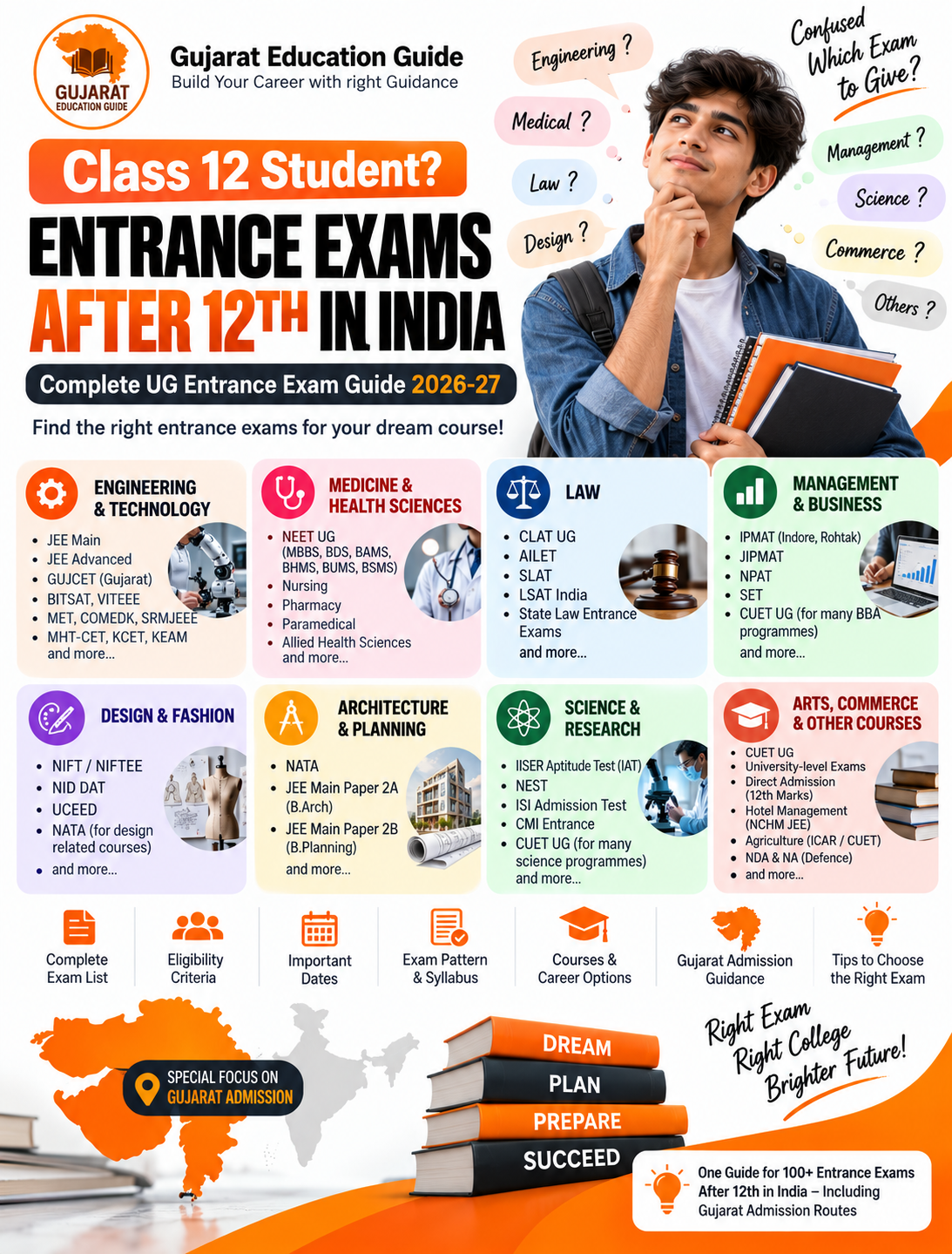
Choosing the right course after Class 12 Commerce is an important step towards building a successful career. Students can explore opportunities in accounting, finance, business management, law, economics, banking, digital marketing, analytics, hospitality and entrepreneurship.
This guide explains popular courses after 12th Commerce, eligibility considerations, career opportunities, indicative salary ranges and how to choose a course that matches your interests and long-term goals.
What You Will Learn
- Best degree courses after 12th Commerce
- Professional qualifications such as CA, CS and CMA
- Career options in banking, finance, law and management
- Digital marketing, business analytics and entrepreneurship
- Courses for students without Mathematics
- Indicative salaries and practical course-selection tips
1. Why Choose Commerce?
Commerce helps students understand how businesses, financial institutions and economies operate. It is suitable for learners interested in accounting, taxation, markets, business decisions and entrepreneurship.
Commerce-related studies may cover:
- Accounting and financial reporting
- Business management and administration
- Economics and market behaviour
- Banking, investment and taxation
- Marketing and customer relations
- Entrepreneurship and business planning
Commerce does not lead only to accounting jobs. With suitable education and practical skills, students can also explore law, consulting, hospitality, analytics and public-sector careers.
2. Best Degree Courses After 12th Commerce
Undergraduate degrees provide an academic foundation for employment, professional qualifications or postgraduate study.
A. Bachelor of Commerce (B.Com)
B.Com is suitable for students interested in accounting, finance, taxation, auditing and business operations.
- Typical duration: 3 years; some institutions offer 4-year pathways.
- Eligibility: Class 12, subject to university admission rules.
- Career options: Accounts executive, audit assistant, tax assistant and finance operations executive.
- Further study: M.Com, MBA and eligible professional qualifications.
Suitable for: Students who want a flexible commerce degree and may specialise later.
B. Bachelor of Business Administration (BBA)
BBA focuses on business operations, management, marketing, human resources and organisational decision-making.
- Typical duration: 3 years; some universities offer 4-year programmes.
- Eligibility: Class 12 with the subjects and marks required by the institution.
- Career options: Management trainee, sales executive, marketing executive and operations coordinator.
- Further study: MBA and relevant postgraduate management programmes.
C. Economics (B.A. or B.Sc.)
Economics may suit students interested in markets, public policy, economic development and research.
- Typical duration: 3 or 4 years, depending on the programme.
- Career options: Research assistant, market research analyst and business research roles.
- Further study: Economics, public policy, finance or analytics, subject to eligibility.
Other Undergraduate Options
| Course | Main Focus | Possible Career Areas |
|---|---|---|
| B.Com (Hons.) | Advanced commerce subjects | Accounting, finance and taxation |
| Bachelor of Financial Markets | Financial markets and investments | Financial services and research |
| Bachelor of Banking and Insurance | Banking and insurance operations | Banking services and insurance |
| BCA or business technology programmes | Computing and digital systems | IT and business technology |
| Hotel Management | Hospitality and service management | Hotels, events and guest services |
Important: Course availability, Mathematics requirements and admission rules vary by institution. Verify the latest eligibility criteria before applying.
3. Professional Courses After 12th Commerce
Professional qualifications can help students specialise in accounting, auditing, taxation, corporate compliance and cost management. These pathways involve examinations and may require practical training.
A. Chartered Accountancy (CA)
Administered by the Institute of Chartered Accountants of India (ICAI), CA focuses on accounting, auditing, taxation and financial reporting.
- Suitable for: Students interested in accounts, finance and taxation.
- Career options: Chartered accountant after qualification, auditor and tax professional.
- Pathway: Follow the applicable ICAI entry, examination and training requirements.
B. Company Secretary (CS)
The Institute of Company Secretaries of India (ICSI) administers the CS qualification, which focuses on corporate law, governance and compliance.
- Suitable for: Students interested in business regulations and corporate governance.
- Career options: Company secretary after qualification and compliance professional.
- Pathway: Check the current ICSI entry, examination and training rules.
C. Cost and Management Accountancy (CMA)
The Institute of Cost Accountants of India administers the CMA qualification, focusing on cost accounting, budgeting and financial planning.
- Suitable for: Students interested in cost analysis and budgeting.
- Career options: Cost accountant after qualification and management accounting professional.
- Pathway: Check the institute's current registration and examination requirements.
| Qualification | Primary Focus | Professional Body |
|---|---|---|
| CA | Accounting, audit and taxation | ICAI |
| CS | Corporate law and governance | ICSI |
| CMA | Cost and management accounting | ICMAI |
4. Law Courses After 12th Commerce
Commerce students interested in legislation, contracts, corporate regulations and legal practice can consider integrated undergraduate law degrees.
B.Com LL.B. and Other Integrated Law Degrees
- Typical duration: 5 years for an integrated undergraduate law programme.
- Eligibility: Class 12 and applicable institution or entrance-examination requirements.
- Career options: Legal associate, corporate legal professional and compliance analyst.
- Professional practice: Becoming an advocate requires meeting applicable enrolment requirements.
Compare recognition, curriculum, faculty, internships, fees and placement information before selecting a law college.
5. Banking, Finance and Investment Careers
Students interested in money management, financial markets, lending and insurance can explore suitable degrees and skill-development programmes.
- Banking: Banking operations, customer relationships and financial services support.
- Insurance: Claims processing, insurance operations and customer support.
- Investment research: Market analysis and investment-support roles, subject to applicable requirements.
- Financial planning: Budgeting and related financial services, subject to relevant qualifications and regulations.
Career tip: Learn Excel, financial statements, business communication and data interpretation. Regulated financial activities may require specific qualifications or registration.
6. Digital Marketing After 12th Commerce
Digital marketing combines business knowledge with online communication and customer acquisition. Students can build skills through a degree, diploma, practical training and project work.
Common specialisations include:
- Search engine optimisation (SEO)
- Social media management
- Content writing and strategy
- Paid advertising and campaign management
- Email marketing and customer relationship management
- Website analytics and campaign reporting
A portfolio of projects, sample content and campaign reports can help demonstrate skills to employers. Freelancing income is not guaranteed and depends on clients and results.
7. Business Analytics and Data Analytics
Business analytics uses data to understand sales, customers, operations and business performance. Commerce students can explore this field through suitable programmes and additional technical training.
- Excel: Calculations, spreadsheets and reports.
- Statistics: Understanding patterns and interpreting data.
- Power BI or similar tools: Dashboards and visual reports.
- SQL: Retrieving information from databases.
- Communication: Explaining findings to business teams.
Mathematics requirements vary by programme and employer. Check eligibility before choosing a specialised analytics degree.
8. Hotel Management, Aviation and Travel
Students who prefer service-oriented and people-facing careers can explore hospitality, aviation-related services, travel management and event management.
| Study Area | Possible Roles | Useful Skills |
|---|---|---|
| Hotel Management | Hotel operations and guest services | Service and teamwork |
| Aviation Services | Ground and passenger services | Communication and customer service |
| Travel and Tourism | Travel operations and itinerary support | Planning and destination knowledge |
| Event Management | Event and client coordination | Organisation and budgeting |
Check programme recognition, practical training, internships and role-specific eligibility before enrolling.
9. Entrepreneurship and Starting a Business
Commerce can provide a useful foundation for students who want to start or manage a business. Success also depends on customer research, practical experience, financial discipline and applicable legal requirements.
- E-commerce and online retail
- Digital marketing and creative services
- Business support services, within applicable professional rules
- Education and training services
- Retail, distribution and trading
- Event planning and hospitality services
Research customer needs, estimate costs and test demand before investing significant money in a business idea.
10. Career Options Without Mathematics
Students who studied Commerce without Mathematics may still have several educational pathways. Eligibility depends on the university, programme and professional qualification.
- B.Com and eligible commerce degrees
- BBA programmes accepting the student's subjects
- CS and other professional pathways, subject to current rules
- Integrated law programmes for eligible students
- Digital marketing and content-related programmes
- Hotel management, travel and tourism
- Entrepreneurship and business programmes
Before applying: Check subject requirements, minimum marks, entrance examinations and any additional conditions in the latest official admission notification.
11. Government Career Options for Commerce Students
Commerce students can explore government and public-sector recruitment after meeting the specific eligibility criteria for each examination and post.
- Staff Selection Commission (SSC) examinations
- Eligible banking recruitment examinations
- Insurance-sector recruitment
- Railway recruitment for eligible posts
- UPSC and Gujarat Public Service Commission (GPSC) examinations
- Income-tax and other departmental vacancies
Age limits, qualifications and selection processes differ by vacancy. Always read the relevant official recruitment notification.
12. Salary After 12th Commerce
Earnings depend on the job, employer, location, qualifications, practical skills and experience. The following are broad illustrative annual salary ranges for selected early-career roles in India. They are not guaranteed salaries or verified 2026 market averages.
| Career Area | Illustrative Annual Range | Key Factors |
|---|---|---|
| Accounting and finance support | ₹2.5–6 LPA | Skills and experience |
| Business and management | ₹3–8 LPA | Role and industry |
| Digital marketing | ₹2.5–7 LPA | Portfolio and results |
| Business or data analytics | ₹3.5–9 LPA | Technical skills and role |
| Hospitality and travel | ₹2–6 LPA | Employer and job function |
LPA means lakhs per annum. Actual salaries may be lower or higher than these illustrative ranges. Professional salaries in CA, CS, CMA, law, finance and management vary widely.
Compare college placement reports, job roles, the number of students placed and the reporting period. Do not choose a course based only on the highest advertised salary.
13. Which Course Is Best for Your Interests?
There is no single best course for everyone. Use your interests and preferred work style to shortlist suitable options.
| Your Interest | Courses to Explore |
|---|---|
| Accounting and taxation | B.Com, CA, CMA |
| Corporate law and compliance | CS, integrated law degrees |
| Business and management | BBA, B.Com |
| Economics and research | Economics and research pathways |
| Digital and creative work | Digital marketing and media |
| Data and business insights | Eligible analytics programmes |
| Travel and customer service | Hotel management and tourism |
| Business ownership | BBA, B.Com and entrepreneurship training |
14. How to Choose the Right Course
- Identify your interests. Decide whether you prefer numbers, business, law, research, communication or creative work.
- Check eligibility. Confirm subjects, minimum marks and entrance examinations.
- Compare total costs. Include tuition, accommodation, transport and examination expenses.
- Research institutions. Review recognition, curriculum, internships and placement information.
- Understand the career pathway. Check whether professional qualifications, registration or postgraduate study are required.
- Build practical skills. Improve communication, digital literacy and field-specific knowledge.
- Make an informed decision. Balance interests, affordability and long-term career goals.
Commerce Career Checklist
- Shortlist at least three suitable courses.
- Verify current eligibility and admission rules.
- Compare fees and course duration.
- Review realistic career and salary information.
- Check official college and placement information.
- Track deadlines and required documents.
15. Frequently Asked Questions
Which course is best after 12th Commerce?
The best course depends on your interests and career goals. B.Com may suit students interested in accounting and finance, while BBA may suit those interested in management. CA, CS, CMA, law, economics, marketing and analytics offer other pathways.
Can Commerce students pursue careers without Mathematics?
Yes. Many commerce, management, law, marketing and hospitality pathways may be available without Mathematics. Some programmes have specific subject requirements, so check eligibility carefully.
Is B.Com or BBA better?
B.Com generally focuses more on commerce, accounting and finance, while BBA typically emphasises management and business operations. Compare the actual curriculum, fees and career pathways.
Can Commerce students pursue law?
Yes. Eligible students can consider integrated law programmes after Class 12. Admission rules and entrance examinations vary by institution.
Which Commerce career has the highest salary?
Experienced professionals in finance, consulting, corporate law, management and qualified professional practice can earn well. There is no guaranteed highest-paying course; results depend on skills, experience and the employer.
Should I choose a course only because of salary?
No. Consider your interests, aptitude, affordability, eligibility, career opportunities and the day-to-day responsibilities of the job.
Conclusion: Build the Right Career After 12th Commerce
Commerce students can explore accounting, finance, management, law, economics, banking, digital marketing, analytics, hospitality, government recruitment and entrepreneurship. The right pathway is one that matches your interests, academic strengths, eligibility and ambitions.
Before taking admission, compare course structure, total fees, institution quality and career opportunities. Verify important details with official universities, professional bodies and recruitment authorities.
Need Career Guidance After 12th Commerce?
Gujarat Education Guide helps students and parents understand course options, eligibility criteria, college choices and admission processes.
Our guidance includes:
- Career and course guidance
- Course and college shortlisting
- Eligibility and admission-process guidance
- Career scope and future pathway discussions
Website: www.gujarateducationguide.com
Ahmedabad Branch: A-1210, 12th Floor, Money Plant Highstreet, Jagatpur Road, SG Highway, Gota, Ahmedabad – 382470
Kadi Branch: S-20-21, Bhavya Square, Kadi, Mehsana – 382715
Contact: +91 7405770057 | +91 7777962604
Disclaimer: This article provides general educational and career information. Eligibility, course duration, fees, professional qualification rules, salary levels and recruitment requirements can change. Confirm the latest details with the relevant university, professional body or official recruitment authority before making a decision.